
Vintage Japanese Haori
Authentic vintage haori, individually selected in Japan for their remarkable textiles, motifs, and craftsmanship.
Each garment is one of a kind.
A Garment Meant to Be SeenA haori (羽織) is a traditional Japanese jacket designed to be worn over kimono. Unlike the kimono beneath it, a haori is worn open at the front, creating an elegant outer layer with wide sleeves and a distinctive silhouette.
But perhaps the most captivating part of a vintage haori is its textile.
Woven patterns emerge as the light changes. Embroidered flowers stretch quietly across deep silk. A seemingly simple black garment may reveal an elaborate scene across its back—or an unexpected patterned lining hidden inside.
These details were never merely decoration.
Flowers, plants, landscapes, water and seasonal imagery have long formed part of the visual language of Japanese textiles, giving each garment its own character.
Explore the collection
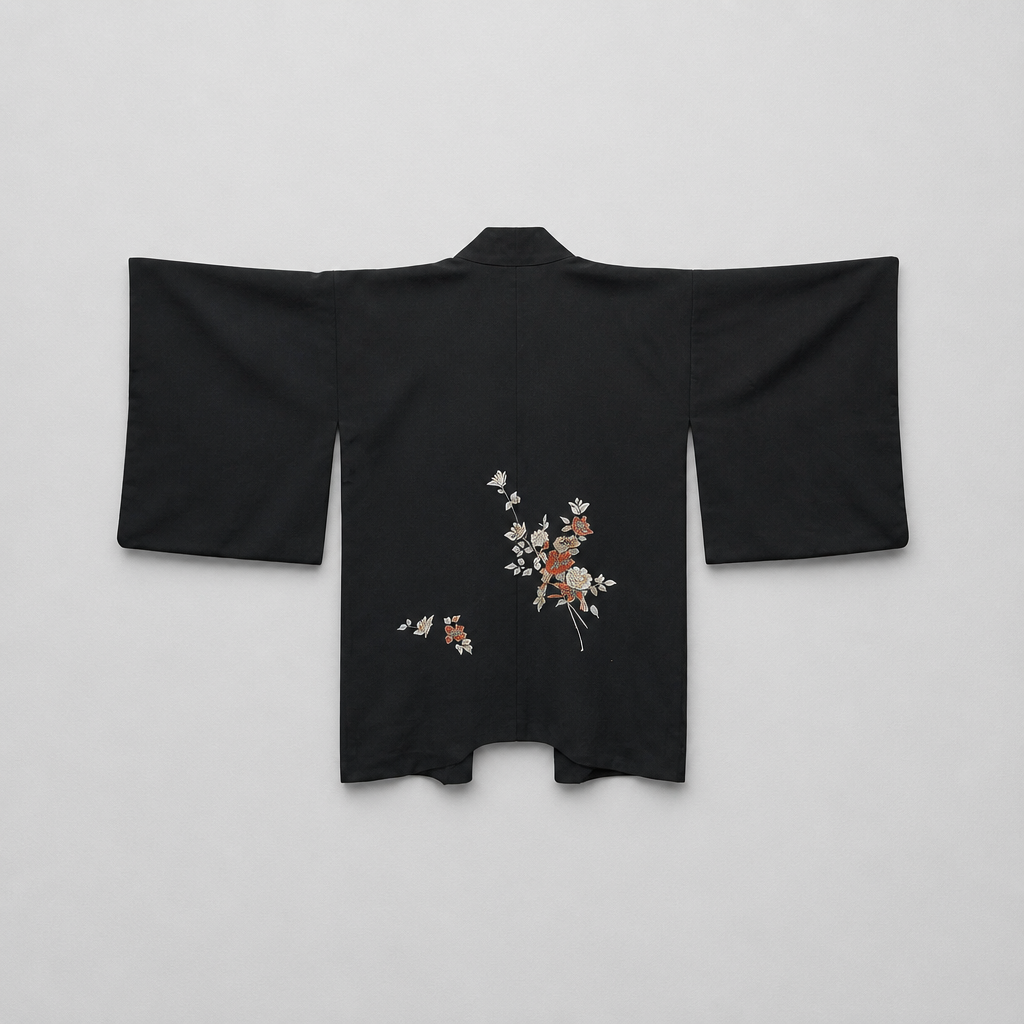
Blushing Rose brings an unexpectedly romantic motif to the traditional Japanese haori.
Across the deep black silk, delicate branches of roses bloom in shades of warm coral, ivory, cream, and muted gold. The largest composition sweeps asymmetrically across the lower back, with smaller blossoms extending onto the front of the garment.
The generous areas of untouched black silk are as important to the composition as the flowers themselves. Rather than covering the garment in decoration, the maker allowed the roses to emerge from open space—creating a design that feels elegant and remarkably modern.
The roses themselves are particularly interesting.
Unlike plum blossoms, chrysanthemums, peonies, and other flowers deeply rooted in classical Japanese decorative traditions, the rose (bara) became increasingly fashionable in Japanese textiles as Western botanical imagery entered Japanese design. Here, the familiar Western flower has been translated through a distinctly Japanese sense of asymmetry, negative space, and restraint.
Inside, Blushing Rose reveals a warm cream silk lining with woven geometric and floral patterning. The tonal design is subtle from a distance but beautifully visible when the silk catches the light.
The original pale haori-himo also remains with the garment.
The result is a piece that bridges two aesthetics beautifully: romantic floral imagery and the disciplined simplicity of the traditional haori silhouette.
Preserved intact and sourced in Japan, Blushing Rose can be worn as a statement layer or appreciated as an original piece of Japanese textile craftsmanship.
One vintage garment. One history. No reproduction.
Details
Garment: Vintage Japanese haori
Name: Blushing Rose
Origin: Japan
Estimated Era: Shōwa period 1960s–1980s
Material: Silk
Exterior: Black silk
Motif: Roses (bara)
Colors: Black, coral, ivory, cream and muted gold
Design placement: Asymmetrical floral compositions across back and front
Lining: Warm ivory patterned silk
Haori-himo: Present
Condition: Very good vintage condition
Quantity: One available
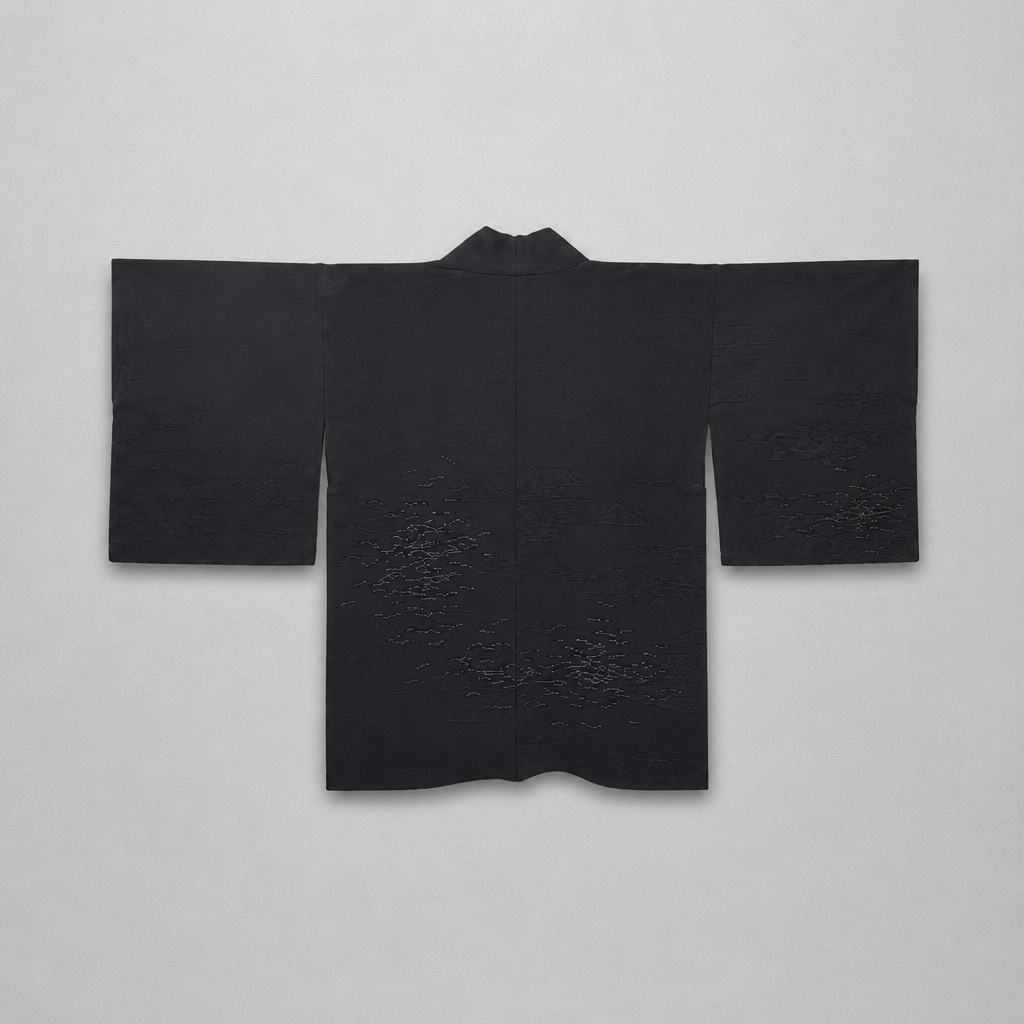
At first glance, Moonlit Waters appears almost entirely black.
Look again.
Across the silk, a landscape slowly emerges.
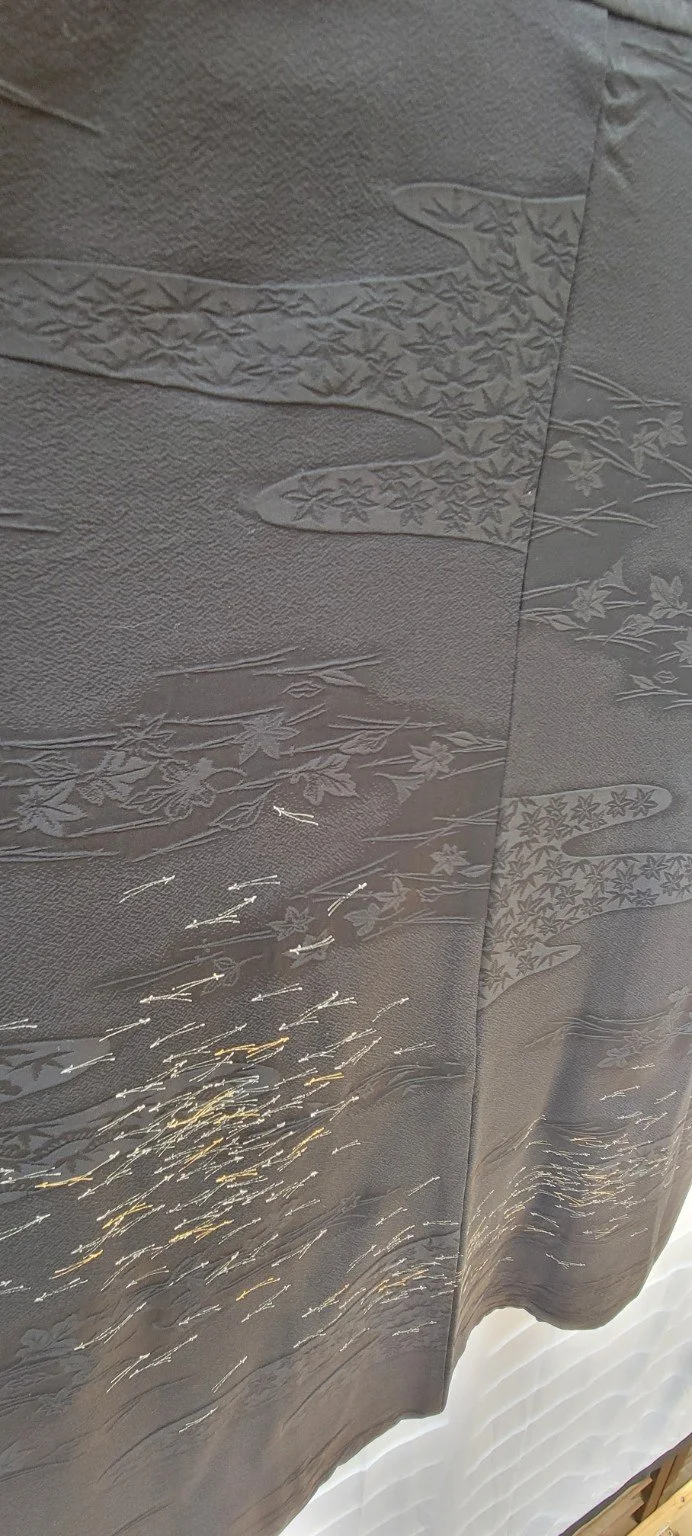
Flowing forms stretch across the back and sleeves in black-on-black relief: rippling water, drifting cloud-like forms, and stylized maple foliage woven into the surface of the garment itself.
The design does not rely on color for its impact. Instead, changes in weave and texture allow the pattern to appear and disappear depending on the angle of the light.
Across the lower back, fine metallic threads interrupt the darkness in scattered strokes of silver and warm gold. They trace the movement of the water rather than outlining it completely, creating the impression of reflected light flickering across a dark surface.
It is an extraordinarily restrained textile.
The pattern continues beyond the central back panel and onto the sleeves, allowing the landscape to travel across the garment rather than existing as a single isolated motif. Even the areas that initially appear plain reveal texture when viewed closely.
Inside, the black exterior gives way to an elegant ivory lining with a subtle woven geometric pattern. An original pale braided haori-himo remains attached, completing the garment.
Moonlit Waters rewards close observation. From across a room, it is minimalist black silk. Up close, it becomes an intricate Japanese landscape rendered almost entirely through texture, shadow and reflected light.
Worn over modern clothing, its monochromatic palette makes it remarkably versatile. Displayed as textile art, changing light continually reveals different portions of the woven landscape.
One vintage garment. One history. No reproduction.
Details
Garment: Vintage Japanese haori
Name: Moonlit Waters
Origin: Japan
Estimated Era: Shōwa period 1960s-1980s
Material: Silk
Exterior: Black figured silk
Motif: Stylized maple foliage, flowing water and landscape forms
Technique: Tone-on-tone woven design with metallic thread accents
Colors: Black with silver and warm gold-toned highlights
Design placement: Continuous landscape across back and sleeves
Lining: Pale ivory figured silk with subtle geometric pattern
Haori-himo: Present; pale braided cord
Condition: Very good vintage condition
Quantity: One available
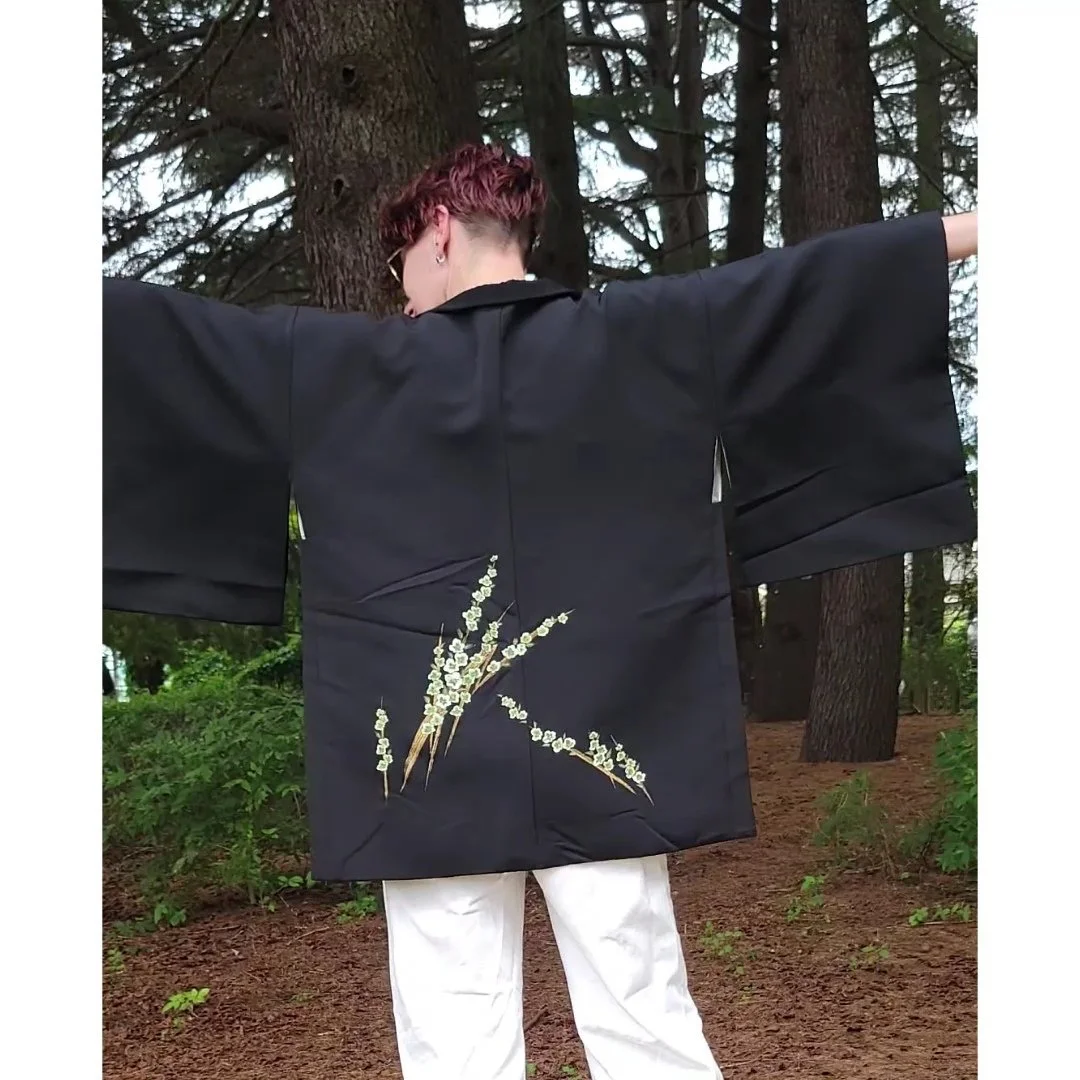
Before the cherry blossoms arrive, the plum trees bloom.
Spring Plum celebrates that first quiet sign of the changing season.
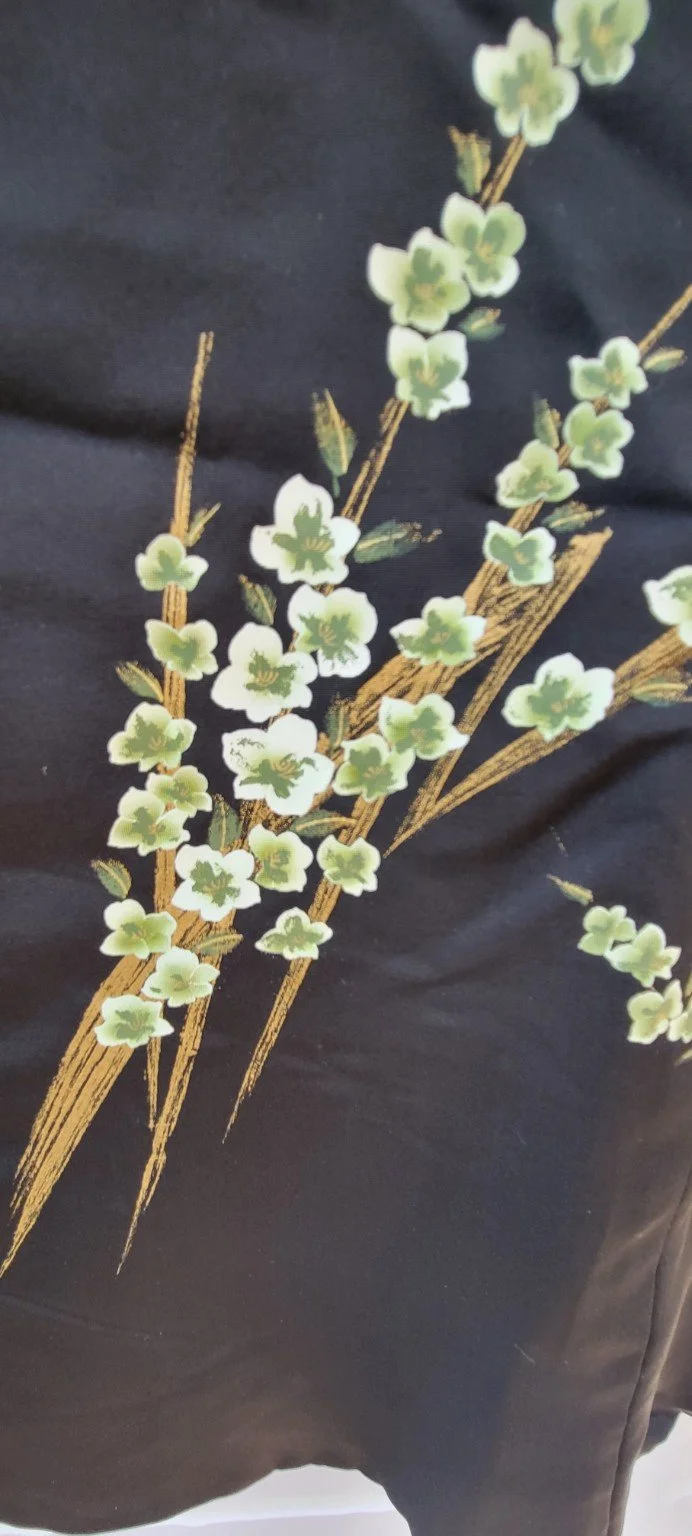
Against a deep black silk ground, slender branches rise across the back of this vintage Japanese haori, covered in delicate blossoms of ivory and soft celadon green. Warm gold-toned branches give the composition structure and a subtle luminosity without overwhelming its restrained palette.
The placement is beautifully spare.
Rather than covering the garment in flowers, the design leaves generous areas of uninterrupted black silk around the blossoms. A principal spray rises diagonally across the lower back, accompanied by smaller branches that give the composition a sense of movement and asymmetry.
A smaller blossom motif appears at the front, offering just a glimpse of the design when the haori is viewed or worn from the front.
In Japanese culture, the plum blossom, or ume (梅), has been admired for centuries. Plum trees bloom while winter still lingers, sometimes pushing their flowers through cold and snow. Because of this, the blossom came to represent perseverance, renewal and hope—the arrival of beauty before spring has fully begun.
Inside, Spring Plum reveals an unexpected second textile story.
The pale ivory lining is patterned with overlapping sensu, or Japanese folding fans, rendered almost entirely through tone-on-tone woven lines. Like the understated exterior, the lining relies on light and texture rather than strong color to reveal its pattern.
The contrast is striking: luminous blossoms against black silk on the outside, an almost ethereal field of folding fans hidden within.
Spring Plum is equally suited to being worn as an elegant statement layer or displayed as Japanese textile art.
One vintage garment. One history. No reproduction.
Details
Garment: Vintage Japanese haori
Name: Spring Plum
Origin: Japan
Estimated Era: Shōwa period 1960s-1980s
Material: Silk
Exterior: Black silk
Primary Motif: Japanese plum blossom / ume
Colors: Black, ivory, pale celadon green and warm gold
Design Placement: Asymmetrical flowering branches across lower back with smaller front motif
Lining: Pale ivory silk with tone-on-tone folding fan design
Condition: Very good vintage condition
Quantity: One available
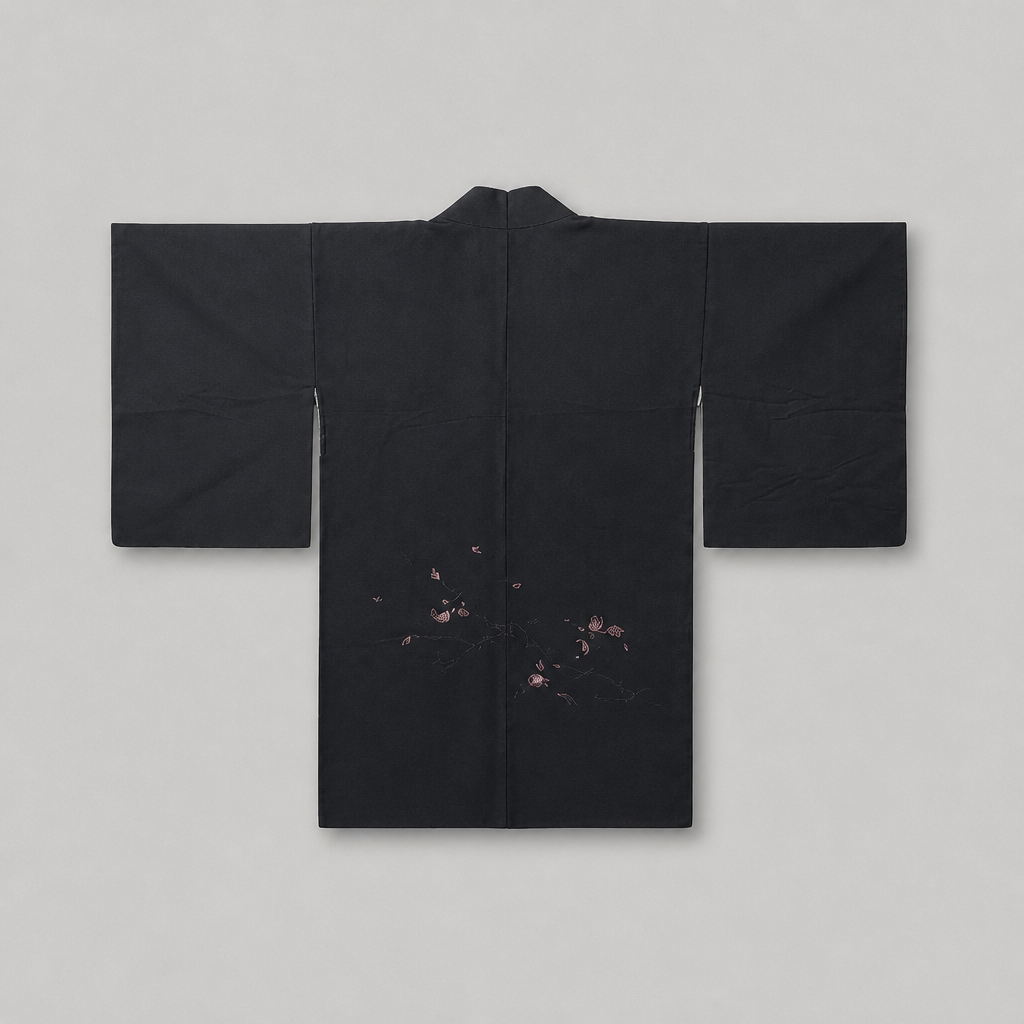
At first glance, Crimson Maple appears almost entirely black.
Look closer.
Across the lower back, dark blue-black branches spread quietly over the silk, punctuated by tiny leaves in crimson, muted gold, and soft blue. The decoration is deliberately restrained: rather than dominating the garment, the motif seems to appear and disappear as light moves across its surface.
This use of tone-on-tone decoration gives Crimson Maple an extraordinary sense of depth. From a distance it is minimal and architectural. Up close, an entire landscape begins to reveal itself.
The scattered colored leaves suggest the fleeting transition of the seasons—a theme deeply embedded in Japanese decorative arts. Rather than depicting autumn in brilliant expanses of red and gold, this textile reduces the idea to a handful of falling leaves against darkness.
That restraint is what makes the piece so compelling.
A small continuation of the motif appears at the front, while most of the decoration remains concentrated across the lower back. The generous negative space allows the few colored details to command attention.
Then there is the interior.
Opening the haori reveals a luminous pale lining decorated with overlapping circular, radiating forms in delicate shades of blue, green, grey, and white. The light interior feels almost startling against the black exterior—a hidden textile composition intended primarily for the wearer.
The original pale haori-himo remains in place.
Crimson Maple is a garment that rewards a second look: quiet from across the room, intricate when viewed closely, and unexpectedly luminous inside.
Preserved intact and sourced in Japan, it can be worn as an elegant statement layer or appreciated as an original piece of Japanese textile craftsmanship.
One vintage garment. One history. No reproduction.
Details
Garment: Vintage Japanese haori
Name: Crimson Maple
Origin: Japan
Estimated Era: Shōwa period 1960s–1980s
Material: Silk
Exterior: Black silk
Motif: Stylized branches and autumn foliage
Colors: Black, blue-black, crimson, muted gold and soft blue
Design placement: Restrained asymmetrical design across lower back with small front detail
Lining: Pale patterned silk with radiating circular motifs
Haori-himo: Present
Condition: Very good vintage condition
Quantity: One available
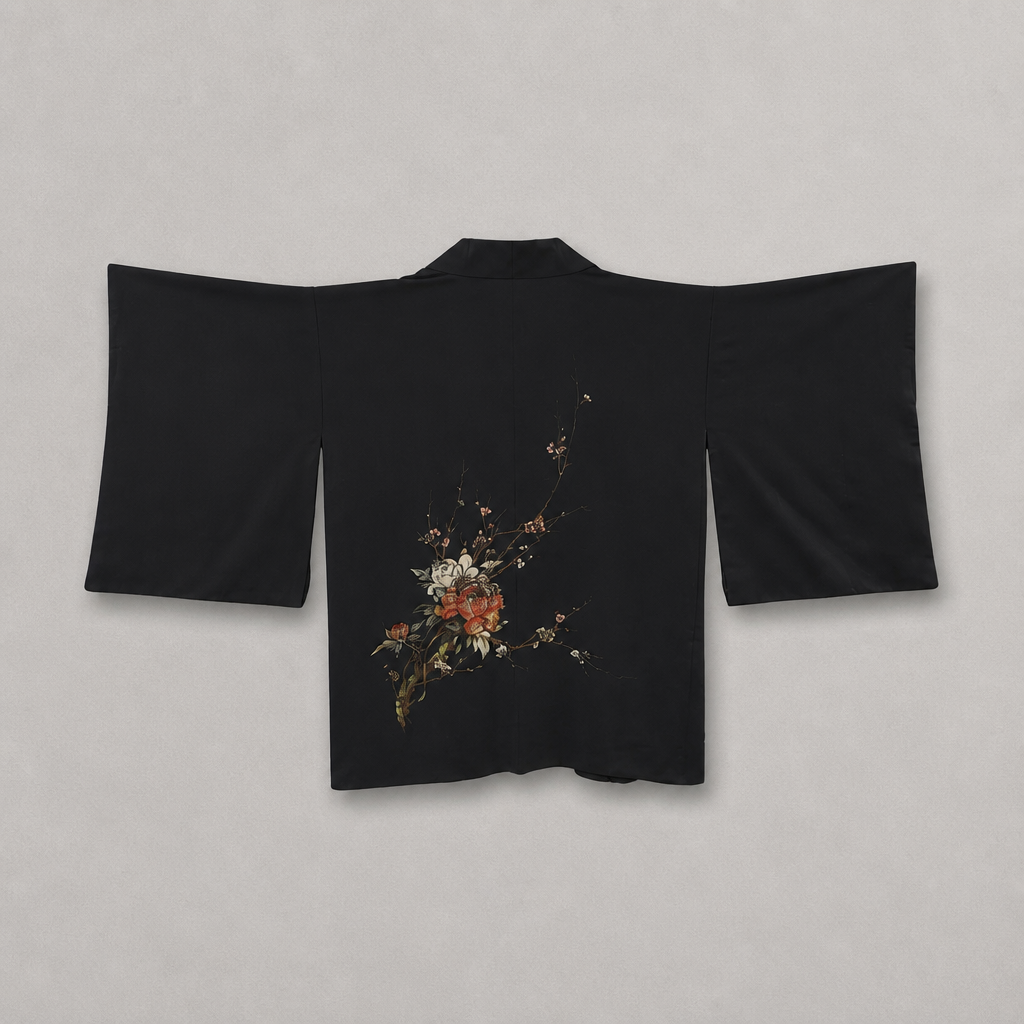
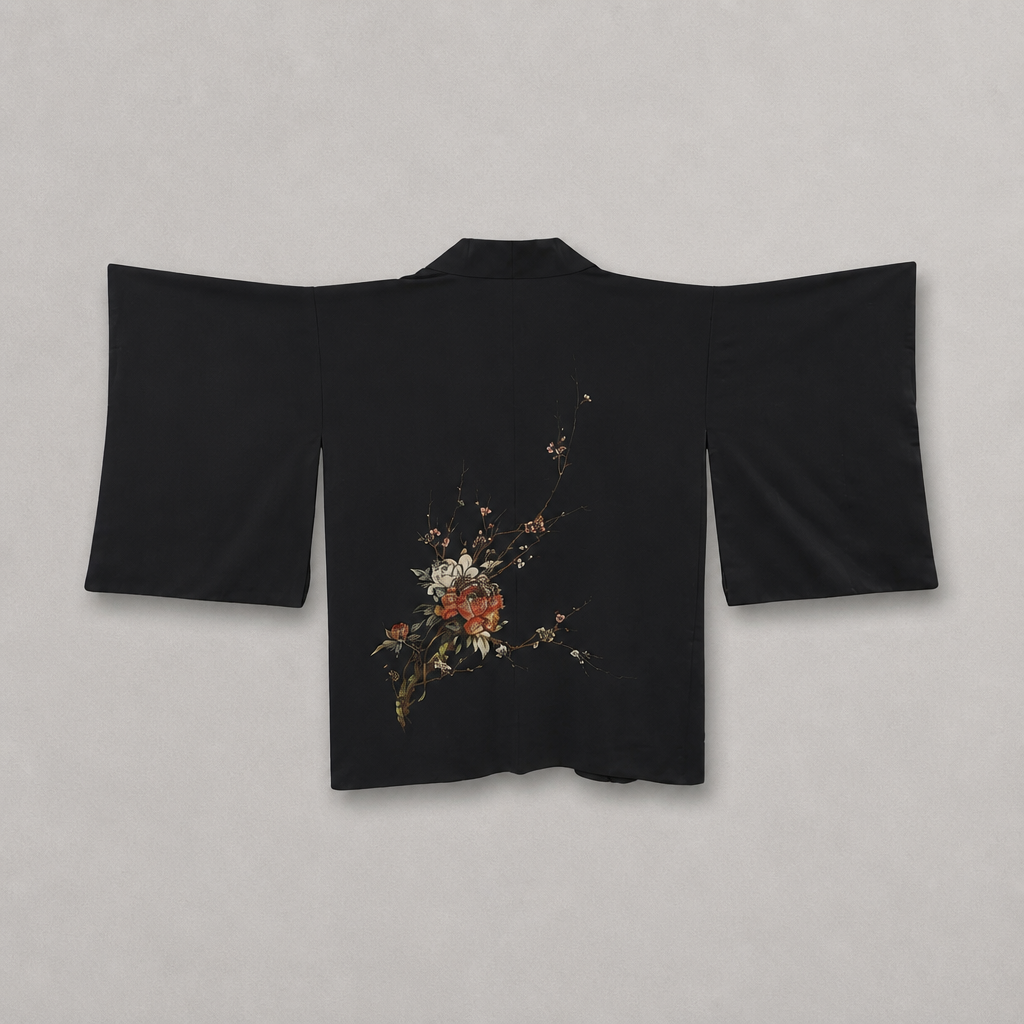
Against a field of deep black silk, Imperial Blossom unfolds like a floral painting.
A dramatic cluster of blossoms rises asymmetrically across the back of this vintage Japanese haori. A magnificent coral-red flower anchors the composition, surrounded by ivory petals, muted metallic tones, touches of green, and slender brown branches scattered with delicate buds and blossoms.
The closer you look, the more intricate the textile becomes.
Individual petals shift between coral, cream, silver-grey and gold-toned threads. Fine changes in weave create highlights and shadows within the flowers, giving the composition remarkable depth against the simplicity of the black ground.
From the central floral cluster, branches extend upward and outward across the garment. Their sparse blossoms create a sense of movement while preserving the generous negative space so characteristic of elegant Japanese textile design.
Rather than covering the garment in decoration, the maker allowed a single composition to command the silk.
The effect is striking without feeling excessive.
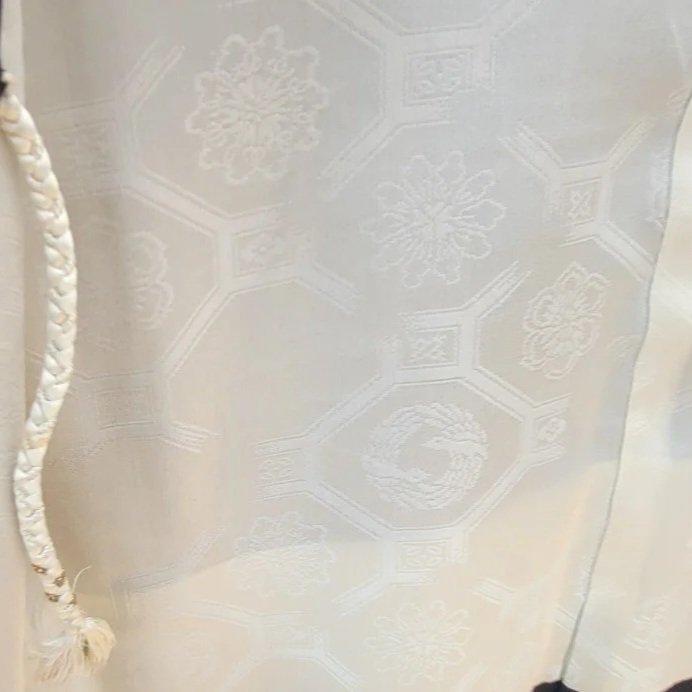
Inside, Imperial Blossom reveals another layer of craftsmanship. The pale ivory lining is woven in a subtle tone-on-tone pattern of interlocking geometric forms containing stylized floral motifs. Because the design is created through the weave rather than strong contrasting color, it appears and disappears as the silk catches the light.
An original pale braided haori-himo completes the garment.
Imperial Blossom is equally compelling worn as a statement layer or displayed as textile art: an original Japanese garment whose beauty lies not only in its bold floral composition, but in the extraordinary details that reveal themselves at close range.
One vintage garment. One history. No reproduction.
Details
Garment: Vintage Japanese haori
Name: Imperial Blossom
Origin: Japan
Estimated Era: Shōwa period 1960s-1980s
Material: Silk
Exterior: Black silk
Motif: Peony-like flowers with flowering branches and buds
Colors: Black, coral red, ivory, gold, silver-grey, brown and soft green
Design placement: Large asymmetrical floral composition across the lower back
Lining: Ivory figured silk with geometric and floral motifs
Haori-himo: Present; pale braided cord
Condition: Very good vintage condition
Quantity: One available
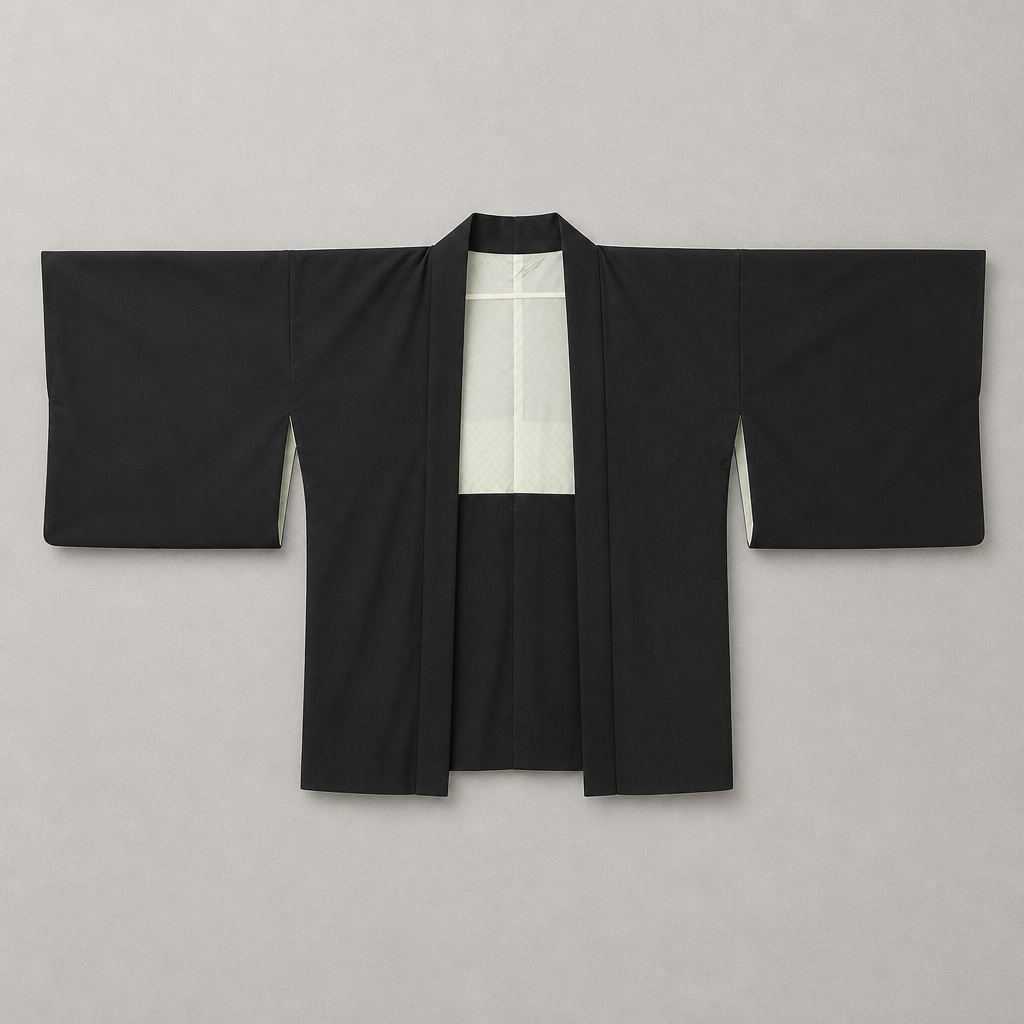
Silent Garden is an exercise in restraint.
At first glance, this vintage Japanese haori appears almost entirely black. Its clean silhouette and deep silk ground are interrupted only by a single small white kamon, or family crest, centered high on the back.
Look more closely and the textile begins to reveal itself.
Subtle woven patterning moves through the black silk, visible as the light changes across its surface. Rather than relying on contrasting color, the design is created through texture and sheen—a quiet detail that makes the garment considerably more complex in person than it first appears.
Inside is an unexpected contrast: a pale mint-ivory lining woven with a delicate geometric lattice. The original haori-himo, the traditional ties used to loosely fasten a haori at the front, remain with the garment.
The contrast between the restrained exterior and decorative interior is particularly characteristic of the understated luxury found in traditional Japanese menswear. Beauty did not always need to be displayed outwardly; some of the most considered details were reserved for the wearer.
Based on its construction and textile, we estimate Silent Garden dates to the late Shōwa period, approximately the 1970s–1980s.
Its simplicity makes it remarkably contemporary today. Worn over trousers, denim, or a simple dress, Silent Garden moves easily beyond its original context while retaining the integrity of the Japanese garment from which it came.
Preserved intact and sourced in Japan, it is offered as both a wearable vintage garment and an example of Japanese textile craftsmanship.
One vintage garment. One history. No reproduction.
Details
Garment: Vintage Japanese haori
Origin: Japan
Estimated Era: Shōwa period 1960s-1980s
Estimated Date: c. 1970s–1980s
Material: Silk
Exterior: Black silk with subtle woven tonal pattern
Kamon: One white family crest (hitotsumon)
Lining: Pale mint-ivory geometric patterned lining
Haori-himo: Present
Condition: Excellent vintage condition
Quantity: One available
Crimson Maple Vintage Silk Haori Kimono
MORE THAN BLACK SILK
Look Closer
From across a room, many traditional haori appear remarkably restrained.
Come closer.
Black silk reveals woven patterns visible only when they catch the light. Gold threads trace across water. Plum blossoms emerge along delicate branches. A flash of ivory lining reveals another textile entirely.
The beauty is often in what wasn't immediately meant to announce itself.
It is this balance between restraint and extraordinary detail that makes these garments so compelling—and makes every haori worth examining closely.
THE MOTIFS
A Language of Seasons
Nature has long provided a rich vocabulary for Japanese textile design.
Plum blossoms announce the approaching spring. Maple leaves mark the changing seasons. Flowers, branches, water and landscape motifs transform silk into something more than surface decoration.
Across this collection, some motifs are immediately visible. Others nearly disappear into the black silk until the fabric moves beneath the light.
Each product page explores the details and motifs found on that individual garment, allowing the textile itself to guide its story.
A SECOND TEXTILE, HIDDEN WITHIN
Beauty on the Inside
Turn a vintage haori over and another story often appears.
The linings of these garments were not treated as an afterthought. Woven geometric patterns, florals, fans and other designs can appear inside—details largely hidden while the garment is being worn.
That quiet attention to an unseen surface is one of our favorite details to discover.
Several haori in this collection reveal beautifully patterned linings, creating an unexpected contrast with their restrained black silk exteriors.
CURATED, NOT RECREATED
Preserved in Its Original Form
Much of the work at Silk Revival Atelier begins with a vintage Japanese textile that can no longer serve its original purpose. Those textiles are carefully transformed into objects designed for a new life.
These haori are different.
They arrived at the Atelier as complete garments worthy of preservation.
Rather than altering them, we chose to offer each in its original form—allowing its craftsmanship, history and textile design to continue exactly as it was created.
These pieces are not reproductions or modern garments inspired by Japanese design. They are authentic vintage Japanese haori, sourced in Japan and individually curated by Silk Revival Atelier.
WEARABLE OR DISPLAYABLE
Wear It. Display It. Preserve It.
A haori does not need to remain tucked away waiting for a traditional occasion.
Its open silhouette makes it surprisingly effortless to wear with contemporary clothing—over a simple dress, trousers, denim or an understated monochrome wardrobe.
And when it isn't being worn?
A beautiful haori can become textile art.
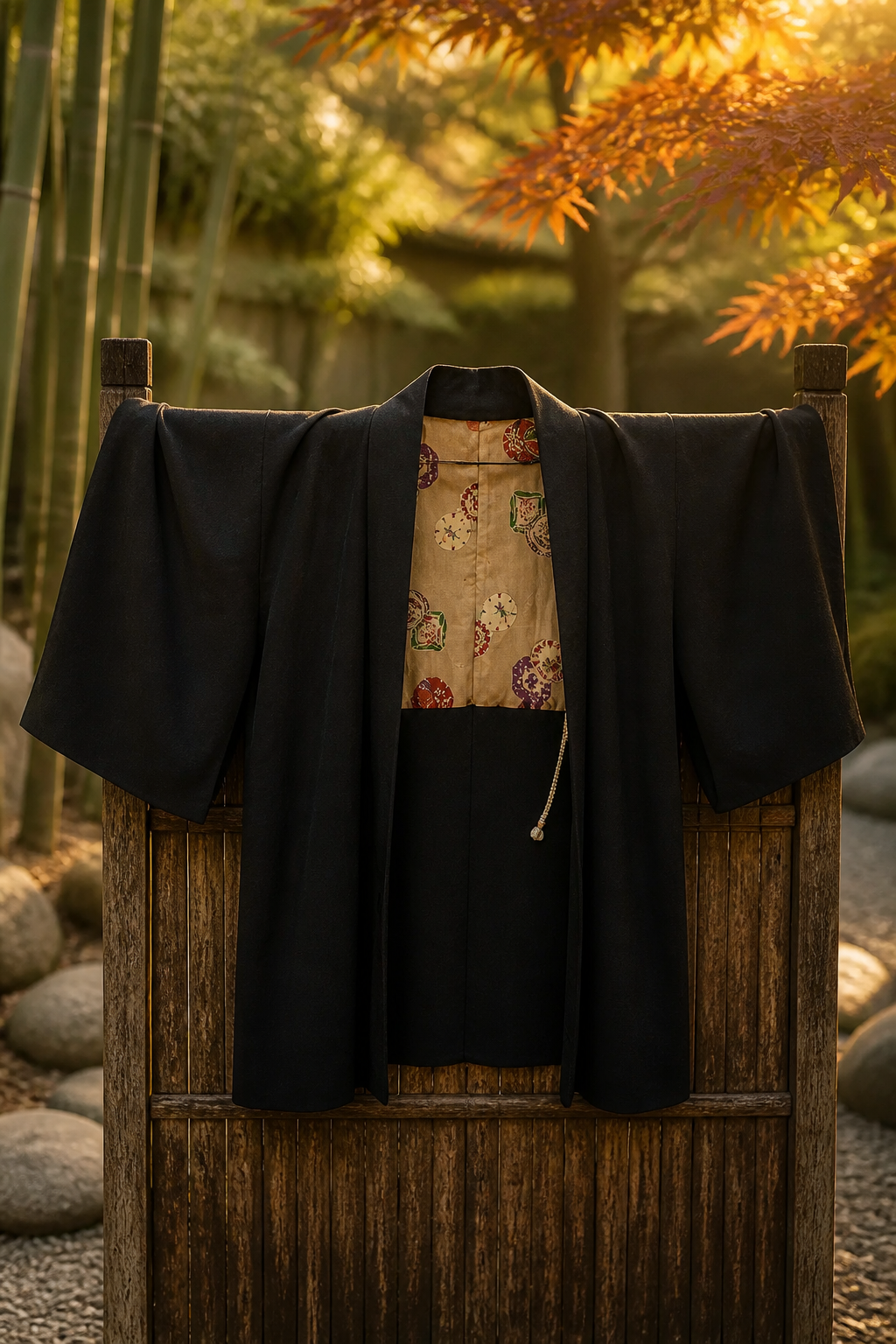
Displayed on a wall or traditional kimono hanger, its wide sleeves and uninterrupted back allow the composition of the textile to be appreciated in an entirely different way.
However it enters your home, it remains what it has always been:
a remarkable piece of Japanese textile craftsmanship.
VINTAGE CONDITION
A Life Before the Atelier
Vintage textiles carry evidence of time.
Each haori has been carefully inspected and its condition documented individually. Depending on the garment, subtle signs of previous wear, storage or age may remain.
We do not consider these pieces interchangeable with newly manufactured clothing.
Their history is part of what makes them extraordinary.
Detailed photographs and condition information are provided on each product page so you can examine your chosen piece carefully before purchasing.
Find the One That Speaks to You
There is only one of each.
Once a haori leaves the Atelier, that exact textile, motif, and history cannot be restocked.